
POKELIKE
POKELIKE
Action Game
Play Pokelike Online
Play Pokelike instantly in your browser and start a fast roguelike run built around starter choices, branching routes, team growth, and turn-based Pokemon battles.
Pokelike takes the familiar rhythm of choosing a partner, fighting trainers, finding wild encounters, and preparing for badges, then turns it into a compact route-based roguelike. Each run asks you to make small decisions often: which starter gives the safest opening, which route node is worth the risk, when to heal, and how to build type coverage before the next challenge.
No download is required. Open the game, choose a mode, pick your starter, and begin routing through the map.

What is Pokelike?
Pokelike is a browser-based Pokemon roguelike focused on short strategic runs. Instead of walking through a fixed story route, you move across a branching map of encounters and choose which risks to take.
The core loop is simple:
- Choose a run mode.
- Select your trainer and starter Pokemon.
- Move through connected route nodes.
- Fight trainers and wild Pokemon.
- Use Pokemon Center, item, and mystery nodes when they appear.
- Improve your team before major badge and boss checks.
The result feels closer to a run-based strategy game than a traditional linear Pokemon adventure. You still care about levels, HP, moves, and type matchups, but route planning matters just as much as individual battles.
How to start a Pokelike run
The title screen currently offers Normal Mode and Nuzlocke. Normal Mode is the best place to learn the systems because you can focus on route decisions, starter strengths, and battle flow before adding stricter challenge rules.
After choosing a mode, the game asks for your trainer avatar and then presents the starter selection screen. In the run I tested, the starter options were Bulbasaur, Charmander, and Squirtle at level 5.
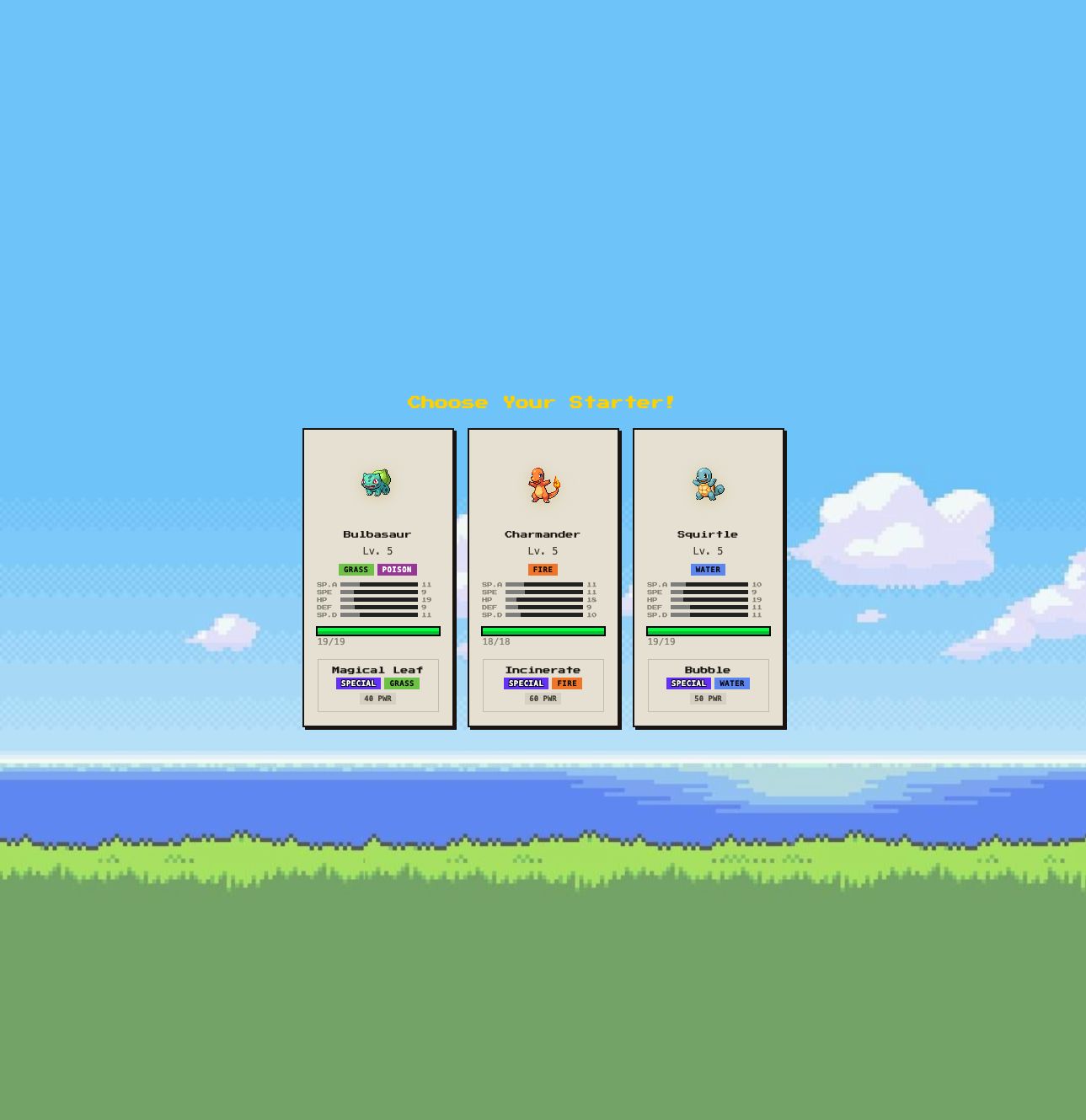
Each starter card shows information that matters immediately:
- Type labels, such as Grass, Poison, Fire, and Water.
- Level and HP.
- Basic stat bars for speed, special attack, special defense, HP, defense, and attack.
- A starting move, its category, its type, and its power.
That makes the opening choice more meaningful than simply picking a favorite. Bulbasaur starts with dual Grass and Poison typing and Magical Leaf. Charmander starts as a Fire attacker with Incinerate. Squirtle gives a Water option with Bubble and slightly different defensive value.
Pokelike gameplay explained
Once the run begins, Pokelike changes into a branching route map. Your team panel appears on the left, while items and badge slots appear on the right. Route nodes are connected by dotted paths, so you cannot jump anywhere you want; you choose from the next connected options.
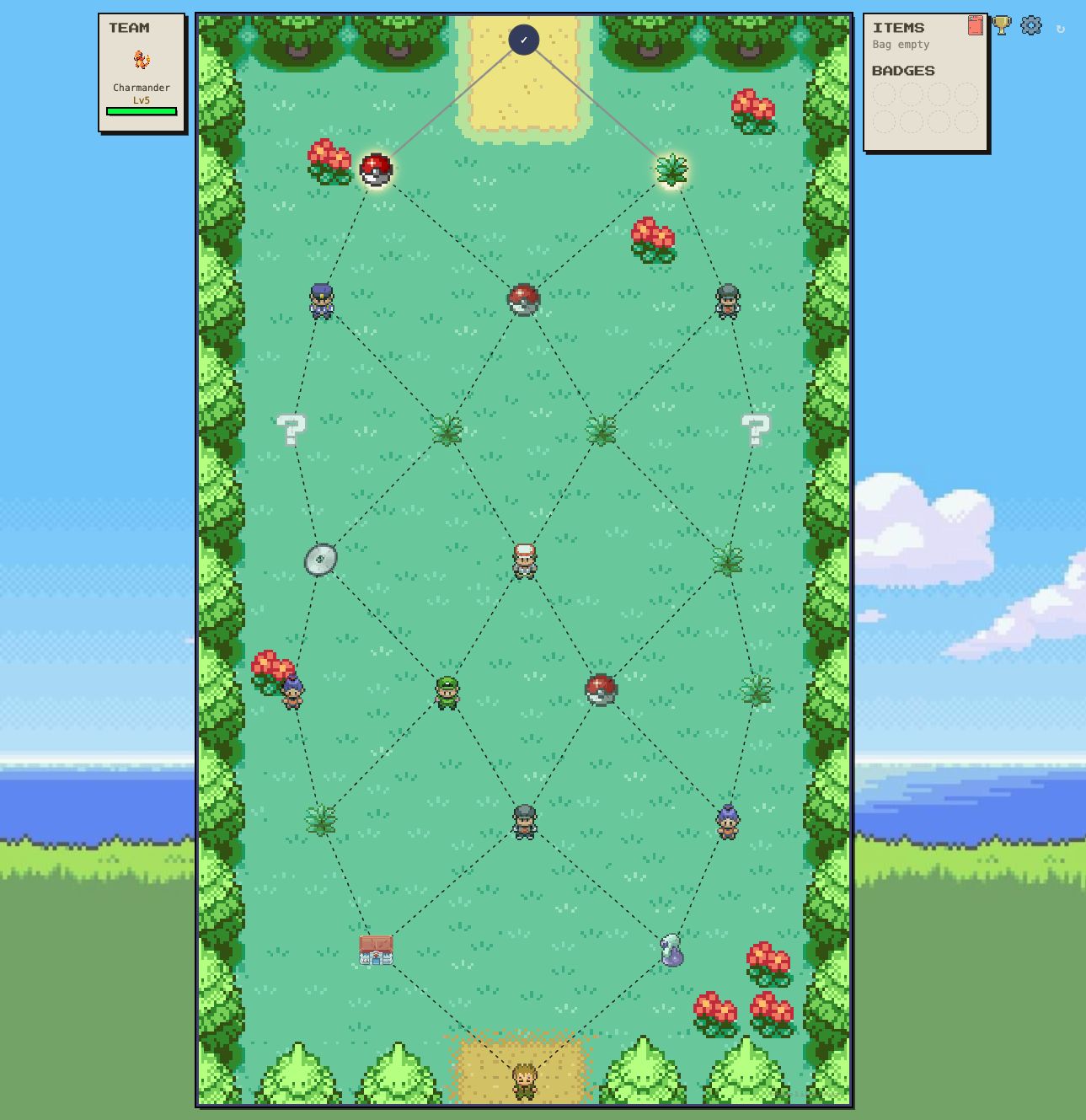
The map uses recognizable node types:
- Trainer sprites usually signal battles.
- Tall grass nodes suggest wild encounters.
- Pokeball nodes suggest rewards or encounter-related events.
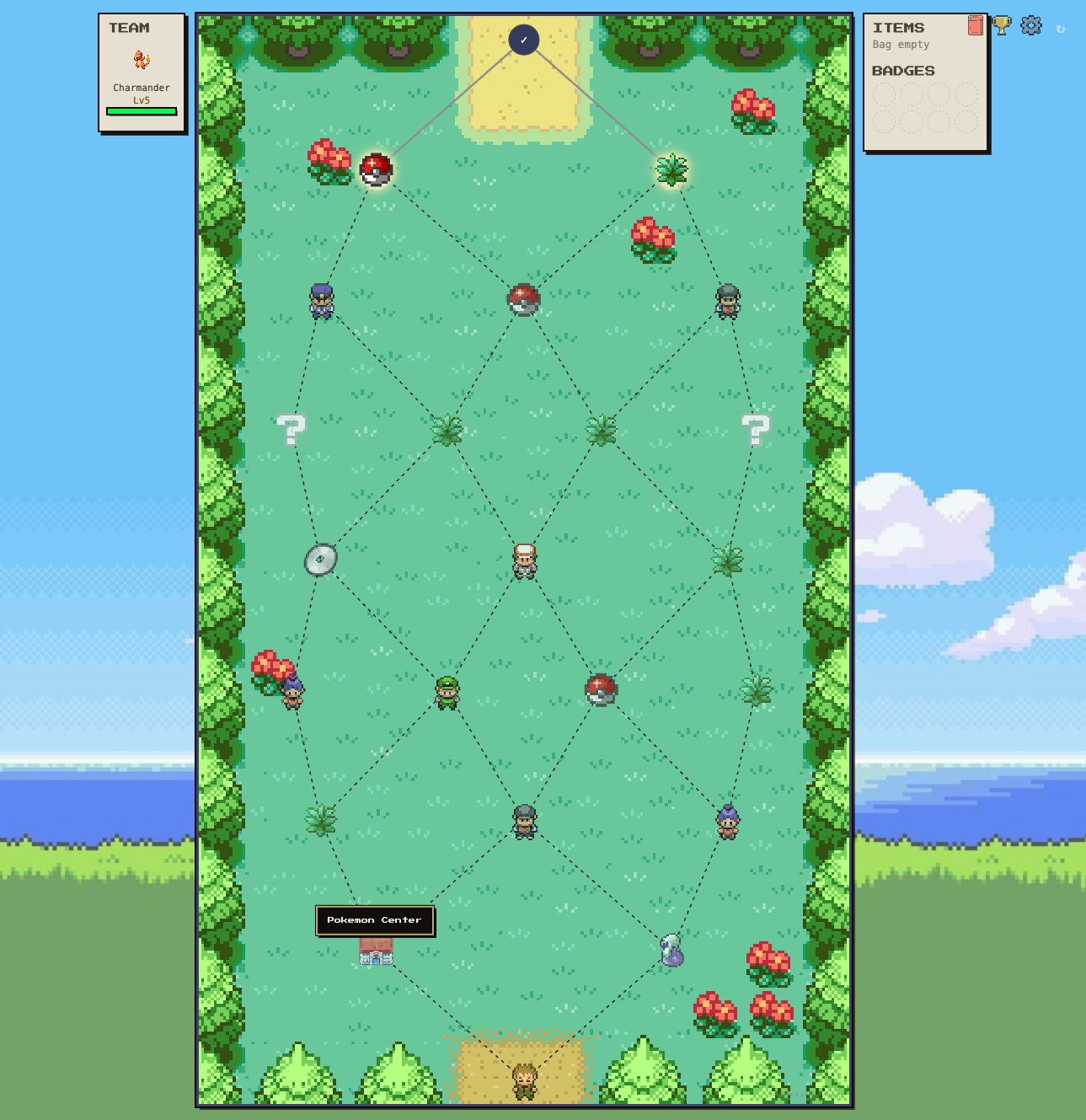
- Pokemon Center nodes give a chance to stabilize your team.
- Question mark nodes add uncertainty and can change the route plan.
- The top checkpoint indicates the direction of long-term progression.
This structure is the heart of the roguelike design. You are not only asking, "Can my Pokemon win this battle?" You are also asking, "Can my team survive the next three decisions if I skip healing now?"
Starter strategy
Your starter sets the tone for the first route. A good first pick gives you enough damage to clear early fights while leaving room to cover weaknesses with future encounters.
Use these early-game guidelines:
- Pick Bulbasaur if you want status-like utility, Grass coverage, and a steadier opening into some common early threats.
- Pick Charmander if you want stronger offensive pressure and are comfortable managing defensive risk.
- Pick Squirtle if you want a safer Water-type start with reliable HP and defensive value.
Do not judge the starter only by its first move. The map will offer more team members and route rewards, so the best starter is the one that helps your whole team survive until those options appear.
Route planning tips
Pokelike rewards careful pathing. Because the map shows several connected routes, you can often compare safer recovery choices against higher-value battle or encounter nodes.
Before selecting a node, check three things:
- Look at your current HP in the team panel.
- Count how many battle-looking nodes are on the path ahead.
- Decide whether your team needs healing, a new Pokemon, or a reward more.
Pokemon Center nodes are especially valuable before a dense section of trainer fights. Wild encounter nodes are useful when your starter needs type support. Mystery nodes can be tempting, but they are best when your current team can handle a bad outcome.
Battle and team building strategy
Winning in Pokelike is not only about having one strong Pokemon. You need a team that can answer different enemy types without running out of HP before the next checkpoint.
A balanced team usually includes:
- A main damage dealer that can finish common fights quickly.
- A bulky Pokemon that can absorb awkward matchups.
- Coverage moves that hit types your starter struggles against.
- A backup attacker in case your lead is low on HP.
- A plan for when to heal instead of taking another fight.
Common mistakes include stacking too many Pokemon with the same weakness, choosing fights while already low on HP, and ignoring route nodes that would repair the run before a harder section.
Pokelike type chart guide
Type matchups matter because each fight is part of a longer resource chain. A single bad matchup can cost enough HP to make the next route choice dangerous.
Players often search for:
- Pokelike type chart
- Pokelike type matchup
- Pokelike weakness guide
- Pokemon roguelike type chart
- tabla de tipos Pokelike
The most important early lesson is to build coverage around your starter. If you begin with Charmander, look for answers to Water, Rock, and Ground-style threats. If you begin with Squirtle, plan for Grass and Electric pressure. If you begin with Bulbasaur, watch for Fire, Flying, Ice, and Psychic problems.
Normal Mode vs Nuzlocke
Normal Mode is the best default recommendation for new players. It lets you learn how starters, map nodes, items, badges, and route pressure work without turning every mistake into a failed run.
Nuzlocke is better once you already understand the map. Because Nuzlocke-style rules usually punish losses and team management errors more severely, route planning and healing decisions become even more important.
Beginner tips
If this is your first Pokelike run, focus on consistency instead of risky optimization.
- Start in Normal Mode.
- Pick a starter whose weaknesses you understand.
- Read the starter card before choosing.
- Watch HP after every fight.
- Use Pokemon Center nodes before long battle chains.
- Add teammates that cover your starter's weak matchups.
- Treat mystery nodes as risk, not guaranteed value.
- Prepare before badge checkpoints.
The best early runs are usually the ones that stay healthy long enough to see more choices.
Frequently asked questions
Is Pokelike free to play?
Yes. Pokelike runs directly in your browser.
Is Pokelike a roguelike game?
Yes. Pokelike uses a run-based structure with starter selection, branching map routes, encounter nodes, and repeated decision-making.
What is the best Pokelike starter?
There is no single best starter for every run. Bulbasaur, Charmander, and Squirtle each create different early strengths and weaknesses. Pick the one whose weak matchups you can cover through later route choices.
How do I win more Pokelike runs?
Win more runs by keeping your team healthy, choosing routes carefully, adding type coverage, and using recovery nodes before difficult sections.
What does the Pokelike route map do?
The route map controls your run path. You move through connected nodes that can include battles, wild encounters, Pokemon Center stops, rewards, mystery events, and checkpoints.